Innovative Plywood Design Ideas for Modern Indian Interiors
From feature walls to curved ceilings, plywood is reshaping Indian interior design. Here is what is possible — and exactly which grades and thicknesses to buy for each application.
Why Plywood Has Become the Designer's First Choice
Plywood is no longer just a structural material hidden inside your walls and cabinets. Over the last decade, Indian interior designers have brought it front and centre — using it as an exposed finish material in homes, offices and commercial spaces.
The shift has been driven by three things. First, plywood's strength-to-weight ratio is better than solid wood — it does not warp, crack or expand with humidity the way solid timber does in Gujarat's climate. Second, it takes finishes exceptionally well: paint, laminate, veneer, wood stain — all bond cleanly to a well-sanded plywood surface. Third, at current market prices in Ahmedabad, quality plywood delivers a high-end look at a fraction of the cost of solid teak or sheesham.
The result is a material that works as well for a ₹10,000 wardrobe as it does for a ₹5 lakh designer living room. You just need to choose the right grade and thickness for the job.
We have supplied plywood to carpenters and interior designers in Ahmedabad for over 45 years. The most common mistake we see is buyers choosing the right design idea but the wrong grade of plywood. A beautiful feature wall built with Commercial Grade plywood in a humid flat will bubble and delaminate within a year. Always match the grade to the application — not just the price to the budget.
Plywood Feature Walls and Wall Panels
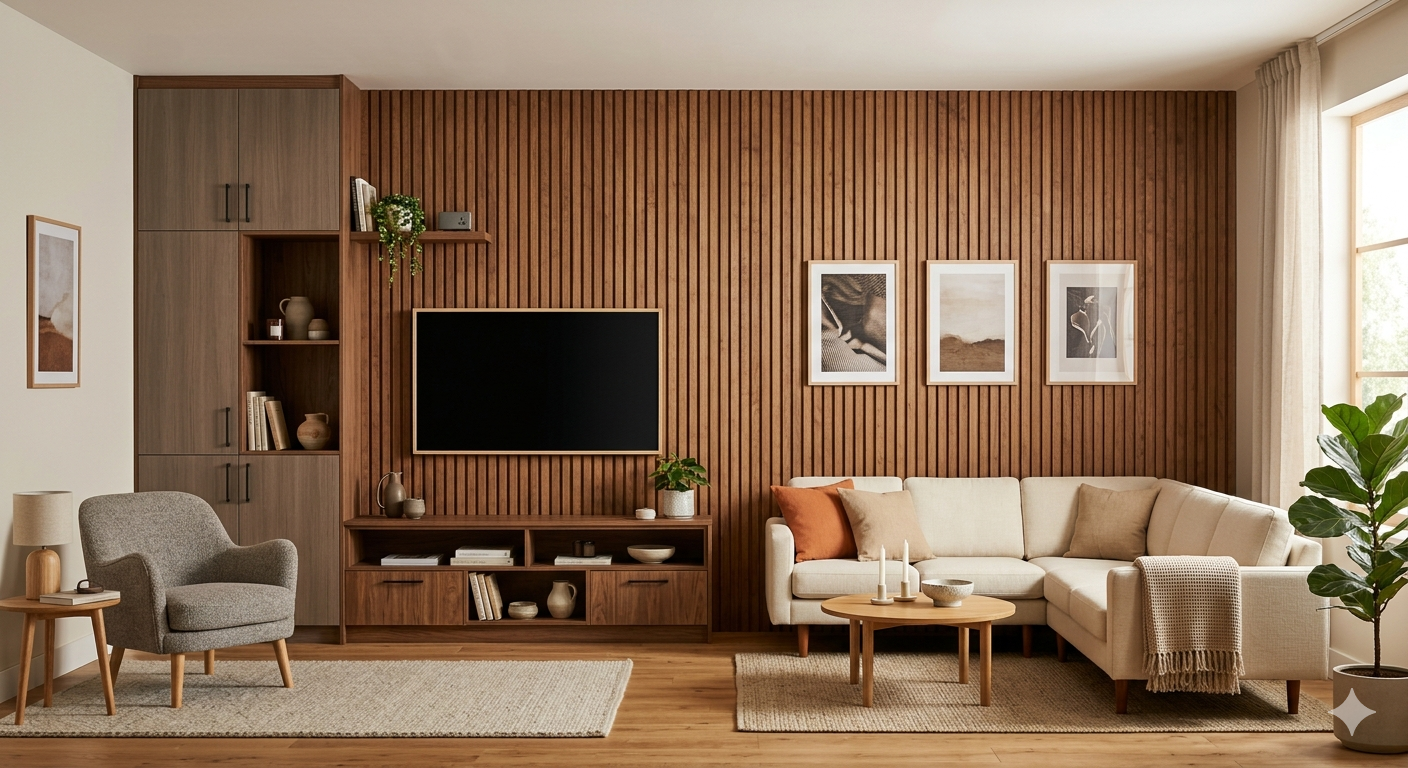
Wall panelling is the fastest-growing application for decorative plywood in Indian homes. Done right, a plywood feature wall looks architectural — rich, warm and distinctly modern — at a cost that drywall or stone cladding cannot match.
Grooved and Ribbed Panels
Vertical or horizontal grooves routed into 12mm plywood sheets create a clean, textured surface. The grooves cast subtle shadows that change with light throughout the day. A popular finish is a matte grey or off-white paint with a single gold accent strip.
Veneer-Finished Accent Walls
A natural wood veneer sheet applied over a plywood backing gives the look of solid timber panelling at a fraction of the cost. Teak, wenge, maple and walnut veneers are popular in Ahmedabad. The plywood substrate keeps the panel dimensionally stable.
Laminate-Finished Plywood Panels
A high-gloss or matte decorative laminate bonded onto 6mm or 9mm plywood is the most cost-effective way to achieve a designed wall. Durian and Greenlam offer over 800 patterns including woodgrain, concrete, fabric and abstract textures.
Thickness guide for wall panelling: 6mm for lightweight decorative panels glued to the wall; 9mm for slightly thicker panels fixed with wooden battens; 12mm for grooved and routed feature walls that need depth.
Creative Plywood Ceiling Designs
Plywood false ceilings are a well-established alternative to gypsum board in Ahmedabad's homes. They are stronger, easier to cut into complex shapes, and screw into without crumbling. These properties make plywood the right material for statement ceiling designs.
Coffered and Grid Ceilings
A coffered ceiling uses a grid of plywood beams to create sunken rectangular or square panels. The depth of the coffering creates dramatic shadow lines and makes a flat ceiling feel architectural. For a modern Indian home, a 75mm deep coffer in 12mm plywood — painted in a warm white with gold or charcoal highlights on the beam faces — transforms a standard room instantly.
Open Raft and Slatted Ceilings
Popular in offices and open-plan living spaces, a raft ceiling uses horizontal strips of 9mm plywood suspended below the main ceiling. The gaps between strips allow HVAC vents and electrical wiring to be concealed while still accessible. This look — raw or lightly stained — photographs exceptionally well and has become a common choice for studios and cafes in Ahmedabad.
Curved and Vaulted Plywood Ceilings
Thin 4mm or 6mm plywood sheets can be bent around a curved frame to create barrel vaults, arched alcoves and wave ceilings. This is a technique carpenters in Ahmedabad use for pooja room ceilings and bedroom alcoves. The plywood is soaked slightly, clamped to the curved substructure and allowed to set. Once dry, it holds the curve permanently.
Always use MR Grade (not Commercial Grade) plywood for ceiling work. Air conditioning creates condensation that Commercial Grade plywood cannot withstand. For AC rooms in Ahmedabad's humid monsoon season, this is not optional — delamination of a Commercial Grade ceiling is a common and expensive repair call.
Plywood Furniture That Doubles as Architecture
The best plywood furniture does two jobs at once — it stores things and it shapes the room. Built-in plywood furniture is one of the most efficient uses of space in Indian homes, where a single unit can replace a wardrobe, bookshelf, TV unit and room divider in one piece.
Floor-to-Ceiling Wardrobes
Built-in wardrobes that go from floor to ceiling eliminate the awkward dust-collecting gap at the top and make the room feel taller. Internal organisation — pull-out trays, trouser rods, soft-close drawers — is built into the plywood carcass.
Bookshelf-Room Dividers
A freestanding plywood bookshelf unit that partially divides a room — open on both sides with alternating shelf depths — acts as both storage and a visual partition. This is especially popular for separating a dining area from a living room in smaller Ahmedabad flats.
Modular Kitchen with Plywood Shutters
The kitchen carcass and shutters are the highest-stress application for plywood in any home. Shutters are opened and closed hundreds of times per week, and kitchen environments involve heat, steam and cleaning chemicals. Use the right grade here — there is no room for compromise.
Plywood Room Dividers and Partition Walls
A partition wall made from plywood gives you the flexibility that brick walls cannot. Plywood partitions can be built quickly, modified later, removed entirely, or repurposed — they are not load-bearing, so no structural permission is required in most residential cases.
Slotted and Lattice Partitions
A slotted plywood partition is made from vertical 18mm panels with horizontal slots cut at regular intervals. The slots allow light and air to pass through while still defining two separate spaces. Finish options include painted, stained, or laminate-wrapped panels. These are common in Ahmedabad offices and co-working spaces.
Geometric Cutout Screens
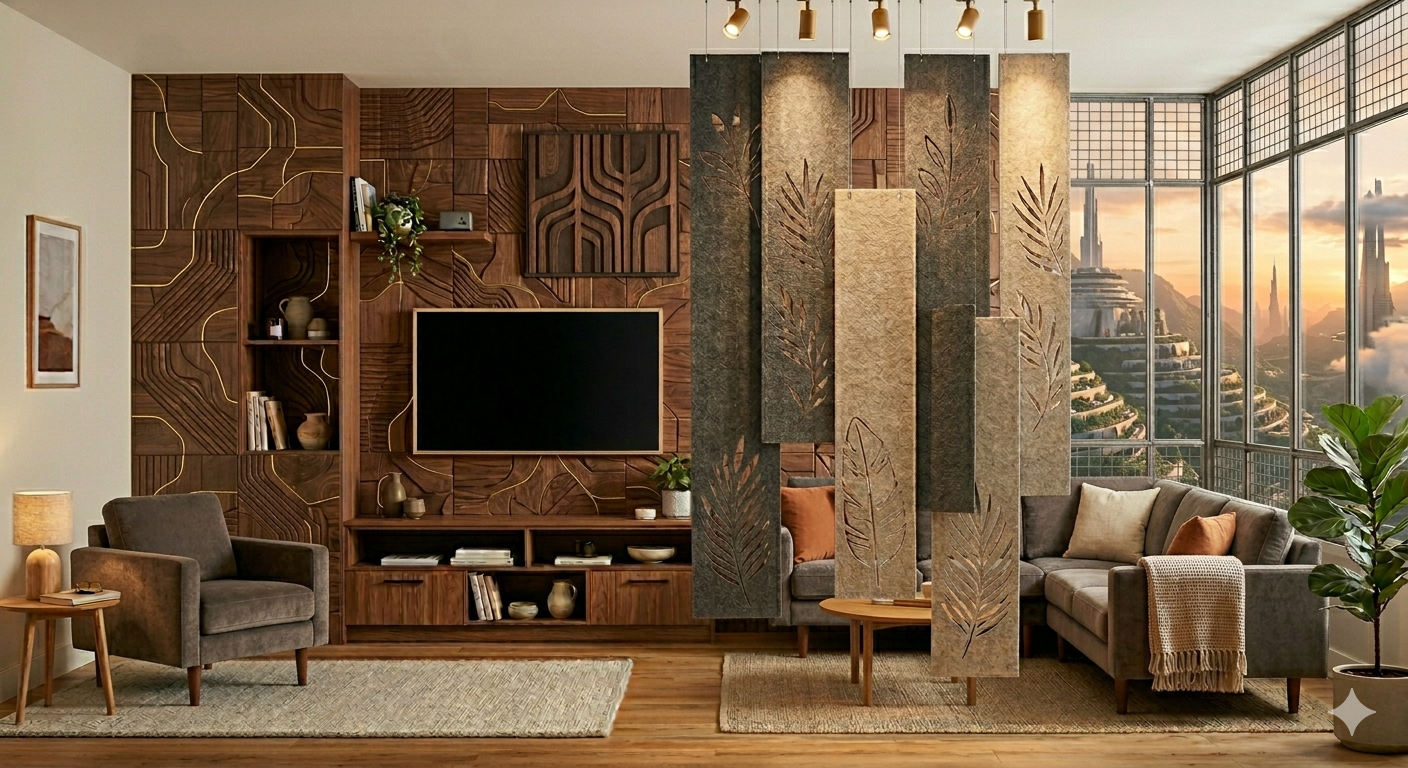
CNC-routed plywood screens with geometric, floral or Islamic geometric patterns are increasingly popular in Indian homes for separating an entrance foyer from the living area. A single sheet of 12mm or 18mm plywood with a laser-cut pattern, backlit with warm LED strips, creates a dramatic effect at relatively low cost.
Choosing the Right Plywood Grade for Each Interior Application
The design idea is only half the decision. The grade and thickness of plywood you choose determines whether the finished work lasts 5 years or 25. Here is a quick reference for Ahmedabad homes.
| Application | Minimum Grade | Recommended Thickness | Recommended Finish |
|---|---|---|---|
| Feature walls (dry rooms) | MR Grade | 6–12mm | Paint or Laminate |
| Feature walls (near kitchen / bathroom) | BWP Grade | 9–12mm | Waterproof Laminate |
| False ceilings | MR Grade | 9–12mm | Primer + Paint |
| Wardrobes and storage carcass | MR Grade | 18mm | Laminate or Veneer |
| Kitchen cabinet carcass | BWP Grade | 18mm | Laminate (Durian / Greenlam) |
| Room dividers and partitions | MR Grade | 12–18mm | Paint, Stain or Laminate |
| Curved furniture and bent panels | MR Grade | 3–4mm (bending) / 6mm (decorative) | Veneer or Paint |
| Beds with storage (below mattress) | MR Grade | 18–19mm for base | Laminate |
All grades mentioned above — Commercial, MR (BWR) and BWP (Marine) — are available at Samta Plywood Centre in Greenply, CenturyPly and Royal Touch brands. For advice on which brand and grade is right for your specific project, WhatsApp or call us directly.
For a deeper explanation of plywood grades and core types, read our Plywood Buying Guide. To see all grades we stock, visit the Plywood Hub.
Frequently Asked Questions
Ready to Start Your Interior Project?
Tell us what you are building and we will advise on the right plywood grade, thickness and laminate to use. Available Mon–Sat, 10 AM to 7:30 PM.
Explore More