
5 Advantages of Using Veneer Sheets in Indian Interior Design
Real wood grain, lasting durability, and a smaller footprint on the environment. Here is why veneer sheets are one of the smartest material choices for Indian homes and interiors.
Why Veneer Sheets Are Chosen for Indian Interiors
Veneer sheets are thin slices of real wood — typically 0.3mm to 3mm thick — bonded onto a stable substrate like plywood or MDF. They deliver the natural character of solid timber at a fraction of the cost, in a form that actually performs better under India's extreme humidity and temperature swings.
Over four decades of supplying interior materials from Lati Bazar, Ahmedabad, we have watched veneer grow from a niche premium choice to a mainstream interior design material. The reasons are straightforward: veneer looks better, lasts longer in Indian conditions, and costs significantly less than solid wood — all while placing a lower demand on forest resources. Below we go through each of these five advantages in detail.
Natural Beauty
Every veneer sheet carries the authentic grain, figure and warmth of real wood — no synthetic finish can replicate it. Available in teak, walnut, oak, wenge and more.
Durability in Indian Climate
Veneer bonded over quality plywood is more dimensionally stable than solid wood — it resists the warping and cracking that India's monsoon and summer cycles cause in solid timber.
Cost-Effectiveness
One log of premium teak or walnut yields hundreds of veneer sheets — making rare, beautiful grain accessible at a fraction of the cost of solid timber furniture.
Design Versatility
From rustic traditional to contemporary minimalist — veneer adapts to every design style, application and room. Walls, wardrobes, doors, ceilings and pooja rooms all work with veneer.
Eco-Friendliness
Veneer consumes far less timber than solid wood for the same coverage area, and engineered veneer uses reconstituted fibres — reducing pressure on natural forest resources.
Natural Beauty — Authentic Wood Grain You Cannot Fake
No printed laminate, PVC film or painted surface can replicate the visual depth of real wood grain. Each veneer sheet is a slice of an actual tree — carrying the unique patterns, figuring, medullary rays and colour variations that formed over decades of growth. This is the fundamental appeal of veneer, and why it remains the preferred finish material for premium Indian interiors.
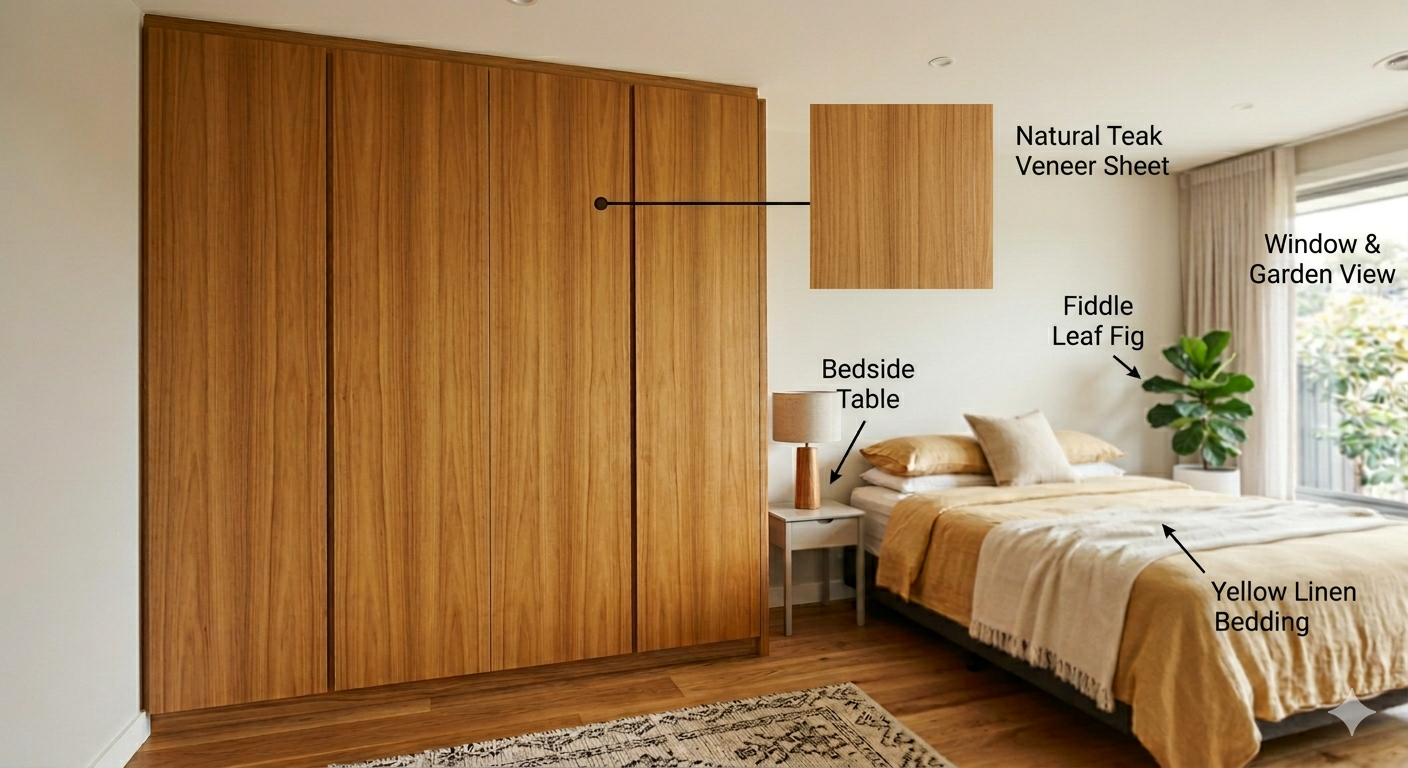
Teak veneer brings the warm golden-brown tones and interlocked grain that Indian design traditions have valued for centuries — it suits both classical carved furniture and clean contemporary wardrobes equally well. Walnut veneer delivers rich chocolate brown tones with occasional figuring that reads as unmistakably luxurious. Oak's prominent ray fleck gives a distinctly Scandinavian or modern feel, while wenge's near-black coarse grain creates bold, dramatic accent panels.
Natural Veneer — The Authentic Choice
- Sliced directly from real logs — every sheet is one-of-a-kind
- Book-matched panels create mirror-image symmetrical feature walls
- Available in teak, walnut, oak, maple, wenge, cherry, ash
- Colour and grain deepen naturally with age and finishing
- PU lacquer brings out the full depth of the grain
Engineered Veneer — Consistency at Scale
- Made from reconstituted wood fibres — consistent grain across batches
- Can replicate rare or exotic species patterns not available naturally
- No knots, colour variation, or grain surprises — ideal for large projects
- More economical than natural veneer for large-scale panelling
- Popular for corporate offices and modular hospitality interiors
The most consistent feedback we hear from customers who choose veneer over laminate is how the room "feels warmer." That is not a vague impression — wood grain genuinely changes the character of a space in a way that printed film finishes do not. A teak-veneered wardrobe in a bedroom has a presence and richness that no decorative laminate replicates, even the best wood-grain prints.
For a deeper look at species selection and where to use each type in your home, see our wood veneer sheets guide — it covers teak, walnut, oak, maple, wenge, cherry and ash with application recommendations for each.
Durability — Why Veneer Outperforms Solid Wood in India
This is the advantage that surprises most people: for Indian climate conditions, veneer over plywood is structurally more durable than solid wood furniture of the same species.
The reason is dimensional stability. Solid wood — even seasoned teak — expands when humidity rises during the monsoon and contracts when the air dries in summer. In Ahmedabad, that humidity swing can move between 40% RH in December and over 85% RH during the monsoon. Repeated expansion and contraction causes solid timber joints to loosen, doors to stick or gap, and panels to crack along the grain over time.
Veneer changes this equation fundamentally. A veneer sheet bonded to MR Grade plywood or BWP waterproof plywood is constrained by the cross-grain structure of the plywood substrate — it cannot expand and contract freely. The result is a surface that maintains its flatness and joint integrity through seasonal changes that would stress solid timber.
| Property | Veneer on Plywood | Solid Wood |
|---|---|---|
| Seasonal movement (humidity change) | Minimal — plywood constrains movement | Significant — expands and contracts |
| Resistance to warping | Excellent | Moderate — prone to warping in humidity |
| Scratch resistance (with PU finish) | Good to Excellent | Good |
| Lifespan in Indian climate | 15–25 years with normal care | 10–20 years — if well maintained and seasoned |
| Resistance to joint failure | High — plywood holds screws firmly | Medium — solid wood joints loosen over time |
| Suitable for kitchen use | Yes — with BWP plywood + sealed finish | Risky — moisture causes cracking and swelling |
A PU lacquer finish on veneer provides significant scratch and stain protection. For kitchens and high-use areas, specify a minimum of three PU lacquer coats with the substrate being BWP Grade plywood. Clean veneer surfaces with a lightly damp cloth — never soak. Avoid placing hot items directly on veneer surfaces.
Cost-Effectiveness — Premium Look Without a Solid Wood Budget
Solid teak or walnut furniture is extraordinarily expensive in India today. A single solid teak wardrobe can cost four to eight times as much as an equivalent-looking veneer-over-plywood wardrobe. The visual difference between the two — once finished with PU lacquer — is negligible to most eyes. The structural difference, as discussed above, actually favours the veneer piece in Indian conditions.
The economics of veneer explain why the price gap is so large. A premium teak or walnut log that might yield only a handful of solid timber boards can be sliced into hundreds — sometimes thousands — of veneer sheets, each carrying the full visual character of the original wood. The material goes dramatically further, which is directly reflected in the lower cost per unit of finished surface area.
Where the Cost Savings Are Largest
- Walnut and teak — rare species where solid timber is scarce and expensive
- Large wardrobe sets, bed panels, and full-room wall panelling
- Feature walls where coverage area is high
- Pooja units and temple furniture where premium species are desired
- Office interiors where large-scale consistency is needed
What You Do Not Sacrifice
- Visual authenticity — real wood grain, not a printed approximation
- Tactile quality — real wood texture under a PU finish
- Longevity — veneer furniture lasts 15–25 years with normal care
- Design flexibility — same species available in multiple cuts and sizes
- Repairability — veneer can be sanded and refinished if damaged
When comparing quotes for interior furniture, always ask whether the quote is for solid wood, veneer over plywood, or laminate over plywood. These are three very different products at three very different price points. A carpenter quoting a "wood finish wardrobe" may mean any of the three. Veneer over good MR Grade plywood with PU lacquer is the right balance of quality, longevity, and cost for most Indian interiors. For a complete comparison of all interior materials, see our interior furniture materials guide.
Design Versatility — One Material, Every Style and Application
Veneer is one of the most design-flexible materials in the interior palette. The same material — veneer over plywood — can achieve the warm richness of a traditional Indian interior, the clean grain-forward aesthetic of Scandinavian design, or the bold drama of a contemporary luxury space. The species and cut type chosen does most of the design work.
Veneer also works across virtually every application in an Indian home. It is equally at home on a wardrobe door as on a feature wall, a flush door, a ceiling panel, a kitchen shutter, or a pooja unit. Compare this with decorative laminates, which work well on flat horizontal surfaces but rarely achieve the same visual depth on vertical feature applications, or with solid wood, which is structurally impractical for large flat panels like wall coverings.
Interior Styles Veneer Suits
- Traditional Indian: Teak veneer with carved MDF detailing for pooja rooms and classical furniture
- Contemporary Modern: Walnut or wenge veneer on flat-panel wardrobes and TV units
- Scandinavian / Minimal: Oak or ash veneer on light-wash wall panels and ceilings
- Luxury / High-End: Book-matched figured walnut or natural burr veneer on feature walls
- Transitional: Teak veneer combined with white laminates for a timeless mixed palette
Applications in the Indian Home
- Feature walls: Book-matched teak or walnut wall panels in living rooms
- Wardrobes: Veneer shutters over MR Grade plywood carcass
- Doors: Veneer flush doors — teak or walnut over hollow or solid core
- Kitchen: Veneer shutters with 3-coat PU finish on BWP plywood base
- Pooja units: Teak veneer with carved detail — warm, traditional richness
- Ceiling panels: Oak or ash linear veneer for bedroom and study rooms
The versatility of veneer also extends to combinations with other materials. Veneer panels paired with decorative laminates in contrasting colours is one of the most popular contemporary interior combinations in Ahmedabad today — the warmth of wood grain alongside the crispness of a gloss or matte laminate panel creates a balanced, sophisticated palette. You can explore how this approach works in our plywood design ideas guide.
Eco-Friendliness — More Wood Coverage, Fewer Trees
The environmental case for veneer over solid wood is compelling and often underappreciated. The core logic is simple: because veneer sheets are very thin — typically 0.6mm to 1mm for standard furniture applications — a single log yields a vastly larger area of finished surface compared to solid timber cut from the same log.
A log that might yield 10–12 solid timber boards, each covering roughly 2 sq m of furniture surface, can be sliced into veneer sheets covering 600–900 sq m of surface — fifty to ninety times the surface coverage from the same log. This is why veneer makes premium wood species like teak, walnut and wenge accessible without placing the same demand on forest resources as solid timber production would.
Natural Veneer — Eco Credentials
- 50–100x more surface coverage per log vs solid timber
- Lower grade wood used for cores, premium wood for faces only
- Many suppliers now source from FSC-certified managed forests
- PU lacquer seals the surface — reduces ongoing maintenance and re-finishing
- Long lifespan (15–25 years) reduces replacement frequency
Engineered Veneer — Next-Level Sustainability
- Made from reconstituted wood fibres — often plantation-sourced
- Can replicate endangered species without harvesting them
- No old-growth forest timber required for production
- Consistent quality reduces waste in cutting and matching
- Lower formaldehyde emissions in modern engineered veneers
When veneer is combined with quality plywood as a substrate, the environmental picture improves further. Plywood itself is a resource-efficient composite — the cross-grain veneer layers use the full width and length of each timber piece with minimal waste. Compare this with solid timber furniture, where much of each log becomes offcuts and sawdust, and the sustainable case for veneer-over-plywood construction becomes very clear.
If environmental credentials are important to your project, ask your supplier whether their veneer is FSC (Forest Stewardship Council) certified. FSC certification means the timber comes from forests managed to strict environmental and social standards. At Samta Plywood Centre, we can advise on FSC-certified plywood substrates for veneer projects — contact us on WhatsApp for current availability.
The Five Advantages — At a Glance
Veneer sheets deliver a unique combination of properties that no single alternative material — solid wood, laminate, or MDF paint — matches across all five dimensions simultaneously.
Natural Beauty
Authentic wood grain, depth and warmth — species-matched from real logs
Durable
More stable than solid wood in Indian climate — resists warping, cracking and joint failure
Cost-Effective
Premium species look at a fraction of solid timber cost — same visual quality, better structural performance
Versatile
Every style, every room, every application — walls, doors, furniture, ceilings and more
Eco-Friendly
50–100x more surface coverage per log vs solid timber — with engineered options using zero old-growth wood
For a complete guide to veneer types, species, application methods and buying tips, read our detailed wood veneer sheets for Indian interiors guide. To compare veneer against laminate, MDF and other interior materials, see our interior furniture materials comparison.
Frequently Asked Questions
Looking for Veneer Sheets in Ahmedabad?
WhatsApp us with your project details — species, quantity and application — and we will advise on availability, pricing and which substrate to pair it with. Mon–Sat, 10 AM to 7:30 PM.
Explore More