
The Timeless Appeal of Wood Veneer for Indian Interiors
Natural wood grain that lasts. Veneer brings the richness of solid timber to furniture, walls and doors at a fraction of the cost — when you know how to choose and use it right.
What Is Wood Veneer and Why Is It Used?
Veneer is a thin slice of real wood — typically 0.3mm to 3mm thick — that is bonded onto a stable substrate such as plywood, MDF or blockboard. The result is a surface with all the visual character of solid timber at a dramatically lower cost and with better dimensional stability.
In Indian interior design, veneer is used wherever a natural wood look is desired without the expense or structural complications of solid timber. A teak or walnut veneer over 18mm MR Grade plywood gives a wardrobe or wall panel the appearance of solid wood while remaining far less susceptible to warping, cracking and swelling in humid conditions.
The core advantage of veneer over solid wood is sustainability: a single log of figured walnut or teak that might yield just a few solid timber boards can be sliced into hundreds of veneer sheets — making rare and beautiful wood grain accessible without depleting the resource.
The most common question we hear at Lati Bazar is: "Is veneer as good as solid wood?" For Indian climate conditions — humidity in monsoon, dryness in summer — veneer over good plywood often performs better than solid wood. Solid teak expands and contracts with seasonal humidity changes. Well-applied veneer on plywood does not.
Natural Veneer vs Engineered Veneer
Natural Veneer
- Sliced directly from real logs
- Every sheet is unique — natural grain variation
- Available in teak, walnut, oak, maple, wenge, cherry
- Matched panels for book-match or slip-match layouts
- Higher cost — especially for figured or rare species
- Best for premium furniture, feature walls, luxury interiors
Engineered Veneer
- Manufactured from reconstituted sustainable wood fibres
- Perfect color and grain consistency across multiple batches—no pattern surprises
- Can replicate exotic wood patterns that are rare or endangered in nature
- Free from natural defects like knots, holes, or sudden color variations
- More economical choice for large-scale corporate paneling and modular spaces
- Easier layout processing with less cutting or balancing sheet waste
Where Veneer Is Used in Indian Interiors
Veneer is one of the most versatile finish materials in interior design. It works equally well on vertical surfaces like walls and doors, horizontal surfaces like tabletops and floors, and three-dimensional objects like furniture carcasses and cabinets.
Veneer Wall Panelling
A book-matched veneer panel — two adjoining sheets opened like a book so their mirror-image grain faces each other — creates a dramatic, symmetrical feature wall. Teak and walnut are the most popular species for living room accent walls in Ahmedabad homes. The substrate is 9mm or 12mm MR Grade plywood fixed to wooden battens on the wall.
Veneer Furniture Surfaces
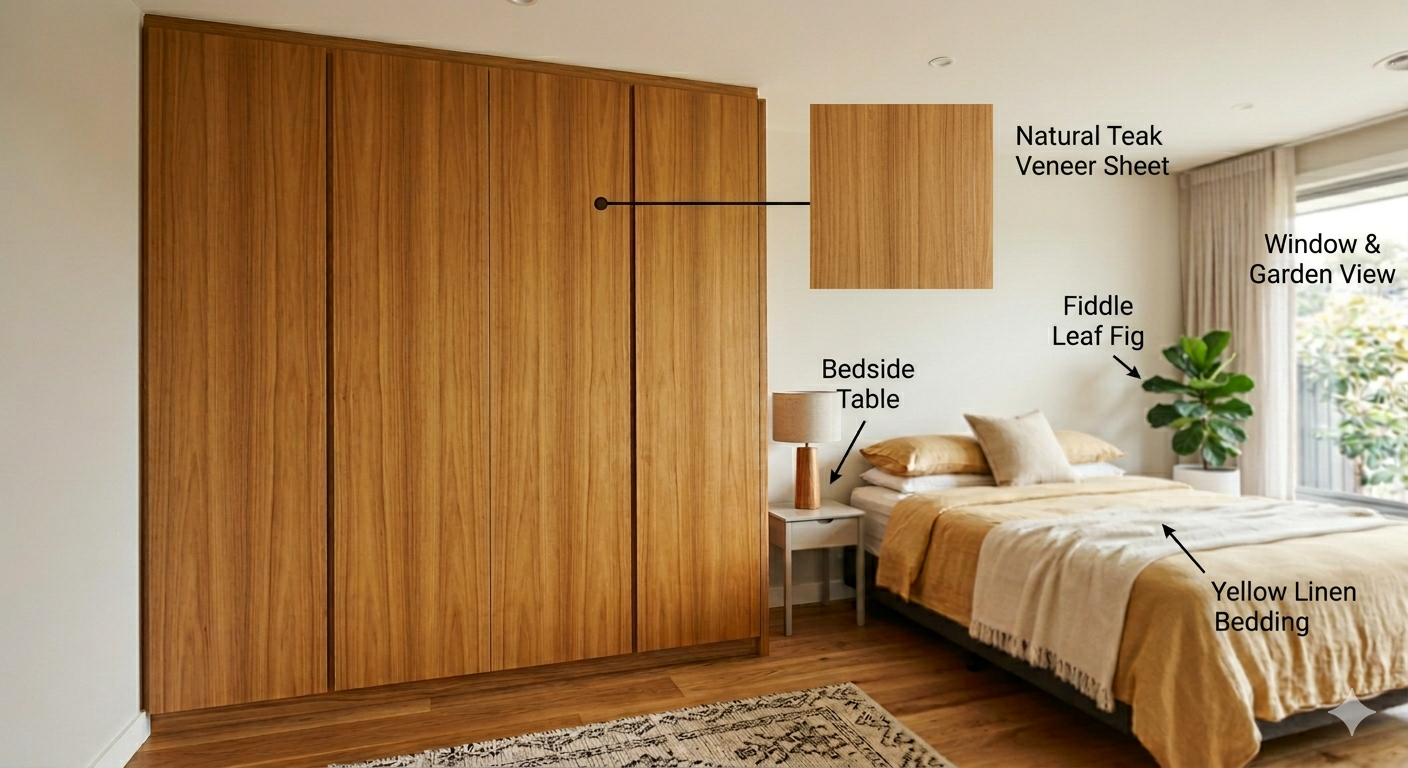
Wardrobes, beds, TV units and dining tables with veneer faces deliver a premium look that painted or laminate finishes cannot replicate. The plywood carcass provides all the structural strength while the veneer provides the aesthetics. A PU lacquer finish over the veneer is standard — it seals the grain and is easy to clean.
Veneer Flush Doors
A flush door with a teak or walnut veneer face immediately elevates the quality perception of any room. Interior veneer doors are made by bonding veneer over a hollow or solid core flush door blank. Exterior-facing veneer doors require a weather-resistant finish — exterior-grade PU or teak oil applied annually.
Veneer Ceiling Panels
Veneer applied to ceiling panels creates a warm, enveloping feel — especially in bedrooms, home offices and study rooms. Linear-grain veneers like oak and ash are popular for ceilings because the straight grain reads well overhead. The substrate is 9mm plywood with the veneer applied before the panel is fixed to the ceiling frame.
Veneer Kitchen Shutters
Veneer kitchen shutters require careful finishing — a minimum of three coats of moisture-resistant PU lacquer, with special attention to the end grain edges where moisture can penetrate. For kitchens in Ahmedabad, use BWP Grade plywood as the substrate and apply an additional sealer coat on exposed edges.
Veneer on Pooja Room & Mandir
The pooja room is often where families invest most in wood finish quality. Veneer — especially teak with its warm golden-brown tone — is a natural fit for pooja units and temple furniture. Carved MDF or solid wood detailing can be combined with veneer flat panels for a traditional richness that laminate cannot achieve.
Choosing the Right Veneer Species for Your Project
The species — the wood type — is the most visible choice in veneer selection. Each species has a distinct colour range, grain character and suitability for different interior styles. Here is a reference for the most commonly used veneer species in Ahmedabad interiors.
| Species | Colour Range | Grain Character | Best Used For | Style |
|---|---|---|---|---|
| Teak | Golden to medium brown | Straight to interlocked, oily surface | Furniture, doors, pooja rooms | Traditional, Classic |
| Walnut | Chocolate brown with grey tones | Straight to wavy, sometimes figured | Feature walls, wardrobes, bed heads | Contemporary, Luxury |
| Oak | Light tan to medium honey | Prominent ray fleck, open grain | Ceilings, wall panels, dining tables | Scandinavian, Modern |
| Maple | Cream to pale gold | Fine, tight, uniform grain | Light-coloured furniture, bedroom | Minimal, Contemporary |
| Wenge | Very dark brown, near black | Straight, coarse grain with pale streaks | Accent walls, TV units, bar cabinets | Bold, Contemporary |
| Cherry | Warm pinkish-red to reddish-brown | Fine, smooth, sometimes wavy | Bedroom furniture, study rooms | Classic, Warm |
| Ash | Light cream with pale brown streaks | Prominent straight grain, open pores | Ceilings, light-wash feature walls | Scandinavian, Airy |
Stock availability of natural veneer species varies. WhatsApp or call us to confirm which species and cut types are currently available at our Lati Bazar store.
How Veneer Is Applied Over Plywood — A Practical Overview
Understanding the application process helps you specify veneer work correctly with your carpenter and avoid common mistakes that lead to bubbling, peeling or uneven grain matching.
Prepare the Substrate
The plywood substrate must be flat, clean and sanded to 120 grit. Any knots, indentations or high spots in the plywood face will telegraph through the thin veneer. Use MR Grade plywood with a smooth okumo or gurjan face for the best bond surface. See our plywood buying guide for substrate selection.
Plan the Layout and Grain Matching
For large panels, lay out all veneer sheets before gluing to plan the grain match. Book-matching (mirror image of adjacent sheets) creates symmetry. Slip-matching (sheets slid sideways, same face) creates a repeating pattern. Random matching uses sheets in sequence with no attempt to match — simpler and more economical.
Apply Adhesive
Contact cement is the standard adhesive for veneer in Indian carpentry workshops. Apply an even coat to both the veneer back and the plywood face. Allow both surfaces to become touch-dry before pressing together. For production work, veneer glue applied in a hot press gives a stronger, more uniform bond.
Press and Bond
Align carefully — contact cement bonds immediately on contact and repositioning is not possible. Use a J-roller or veneer hammer to press firmly from the centre outward, eliminating any air pockets. For curved surfaces, use a curved caul (a shaped pressing block) to ensure full contact during curing.
Sand and Finish
Once bonded, sand the veneer surface lightly with 180 grit, then 240 grit, to smooth any raised grain or seams. Remove all dust before applying finish. Apply a grain filler for open-pore species like oak and ash. Then apply 2–3 coats of PU lacquer, sanding lightly between coats with 320 grit. The final coat determines the sheen level — matte, satin or gloss.
What to Check When Buying Veneer Sheets in Ahmedabad
Thickness: 0.3mm to 0.5mm is paper-backed veneer — flexible, used for curved surfaces or pre-glued sheets. 0.6mm to 1mm is standard furniture veneer. 2mm to 3mm is thick (craft) veneer that can be edge-banded and sanded multiple times.
Backing: Raw veneer (no backing) gives the most natural result but requires more skill to apply. Paper-backed veneer is more stable and easier to handle. Fleece-backed veneer is the most forgiving for curved or irregular surfaces.
Cut type: Flat-sliced (crown cut) veneer shows the widest grain figure — the classic look. Quarter-sliced shows straight parallel lines — cleaner and more consistent. Rotary-cut (peeled from the log like a scroll) shows wild, cathedral grain — usually reserved for lower grades.
Sheet size: Standard Indian veneer sheets are typically available in approximately 2400 × 1200mm. Larger sheets are available for high-end projects but carry a premium. Always buy 10–15% more than your calculated requirement to account for grain matching and cutting waste.
For availability of specific species, cuts and sizes at our Lati Bazar store, WhatsApp your requirement to 8460783619 or call us. We can advise on the best veneer specification for your specific project and budget.
Frequently Asked Questions
Looking for Veneer Sheets in Ahmedabad?
WhatsApp us with your project details — species, quantity and application — and we will advise on availability and pricing. Mon–Sat, 10 AM to 7:30 PM.
Explore More