
MDF Sheets — Uses, Grades & Finishing Guide
From painted wardrobes and CNC wall panels to kitchen shutters and retail fixtures — a practical guide to getting the most out of MDF board for Indian interiors.
What Is MDF — And Why Is It So Popular?
MDF (Medium Density Fibreboard) is an engineered wood panel made by compressing fine wood fibres with resin and wax under heat and pressure. The result is a dense, smooth, homogeneous board with no grain, no knots, and no voids — a surface that machines cleanly and accepts any finish.
Unlike plywood, which has a visible wood grain and varies slightly in density, MDF is perfectly uniform throughout. This consistency is what makes it the material of choice for painted furniture, CNC-routed decorative panels, and modular cabinetry where a flawless finish is the priority.
MDF is available in a wide range of thicknesses — from 3mm thin panels used for back panels and wall cladding to 25mm boards used for thick shelving and cabinet doors. The standard sheet size is 8×4 feet (2440×1220mm), matching plywood. For a detailed breakdown of every MDF grade — Standard, MR-MDF, FR-MDF, HDF, Ultra-Light and Prelam — and a room-by-room selection guide, read our MDF Grades Selection Guide.
We stock standard MDF and Moisture Resistant MDF (MR-MDF) in thicknesses from 6mm to 25mm. If you are planning wardrobes, kitchen shutters, or decorative wall panels and need advice on which grade or thickness suits your project, WhatsApp us the room dimensions and we will guide you.
Six Key Uses of MDF Sheets in Indian Interiors
MDF's uniform surface and easy machinability make it suitable for a broader range of applications than almost any other wood-based panel. Here are the six most common uses in Indian homes and offices.
Wardrobe & Bedroom Furniture
MDF is the dominant material for painted wardrobe shutters and modular bedroom furniture. The smooth face accepts PU paint and lacquer perfectly, creating a furniture-grade finish. Use 18mm for shutters, 12mm for internal panels and shelf backs.
Kitchen Cabinet Shutters
MDF kitchen shutters with a laminate or membrane press finish are the standard in modular kitchens. Use Moisture Resistant MDF (green core) for any area near the sink, hob or steam. Standard MDF will swell irreversibly if it gets wet — even once.
Decorative Wall Panels
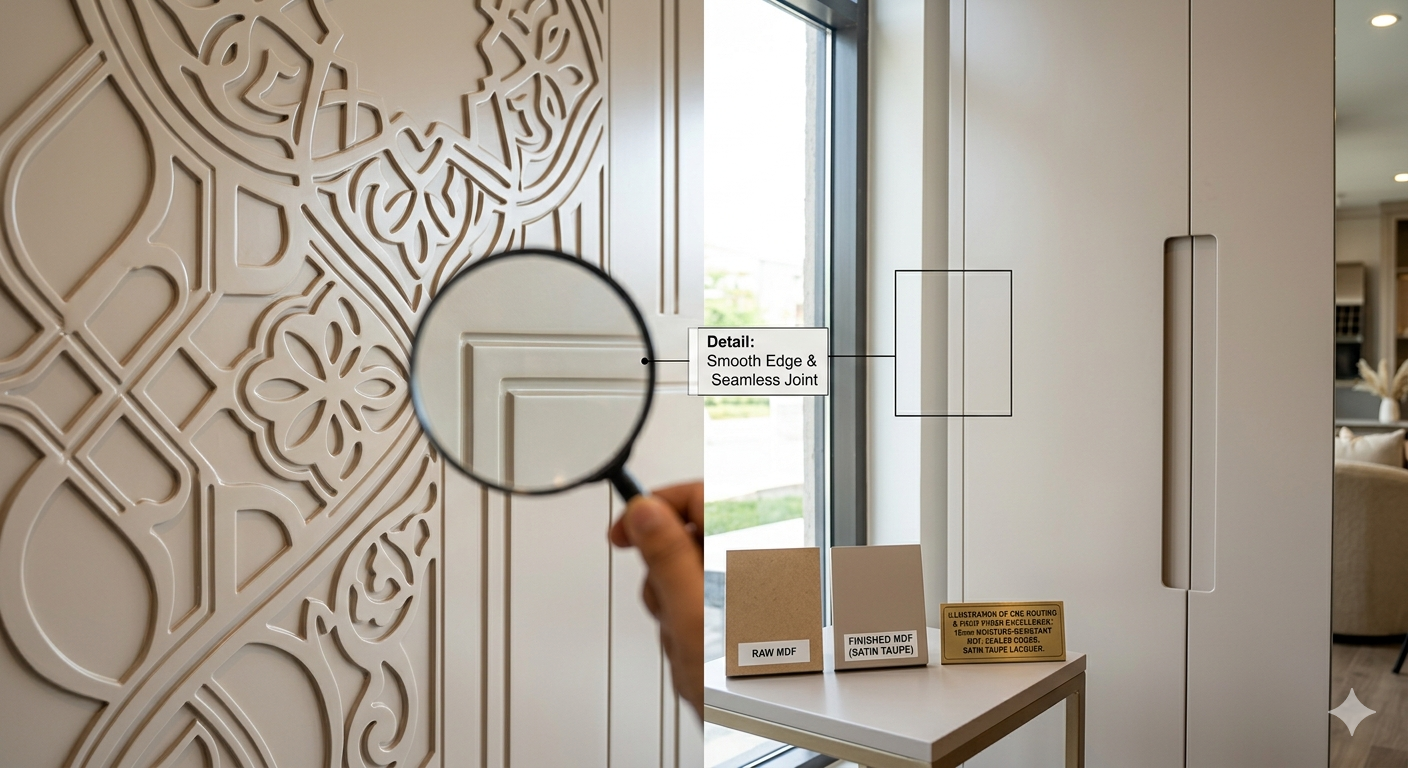
CNC-routed MDF wall panels with geometric, floral or Jaali patterns are the fastest-growing application. 12mm or 18mm MDF is routed on a CNC machine, primed and painted — creating the look of hand-carved wood at a fraction of the cost. Wall cladding in 6mm or 9mm is also popular.
Room Dividers & Partitions
MDF partitions with routed patterns double as decorative room dividers between living and dining areas. The panel can be back-lit with LED strip lights for a dramatic effect. Use 12mm MDF with a solid wooden frame to prevent warping in free-standing partitions.
Modular Storage & Built-ins
MDF is widely used for built-in bookshelves, TV units and study table tops where a painted look is desired. For shelves carrying heavy loads (books, appliances), limit spans to 600mm at 18mm thickness to avoid sagging — or switch to plywood for longer spans.
Exhibition & Retail Fixtures
MDF's ability to be machined precisely and painted to any colour makes it the standard material for display fixtures, signage boards, point-of-sale counters and exhibition stalls. The consistent surface ensures print-quality uniformity when used as a digital print substrate.
MDF Grades and Thickness — Quick Reference
Choosing the correct MDF grade and thickness for your application prevents warping, moisture damage and premature failure. Here is a quick reference for the most common grades available in India. If you are comparing brands, see our guide to Action Tesa MDF boards.
| Grade | Core Colour | Moisture Resistance | Best For | Common Thickness |
|---|---|---|---|---|
| Standard MDF | Beige / off-white | Low — dry interior areas only | Wardrobes, wall panels, painted furniture | 6mm, 9mm, 12mm, 18mm, 25mm |
| MR-MDF (Moisture Resistant) | Green tint | Moderate — kitchen, bathroom areas | Kitchen shutters, bathroom vanities | 9mm, 12mm, 18mm |
| FR-MDF (Fire Retardant) | Red / pink tint | Low | Hotels, offices, public buildings | 12mm, 18mm |
| Ultra-Light MDF | Beige | Low | Wall cladding, ceiling panels, door skins | 3mm, 6mm, 9mm |
How to Finish MDF — Painting, Laminating and Edge Treatment
MDF's porous surface and vulnerable edges require specific preparation for a durable, professional finish. Skipping the prep steps is the most common cause of poor paint results on MDF.
Painting MDF — Correct Sequence
MDF absorbs paint heavily on the first coat — especially at the edges, which are most porous. Follow this sequence for a smooth, furniture-quality painted finish:
- Sand the faces with 150–180 grit to remove surface fuzz from the milling process. Wipe clean with a dry cloth.
- Seal the edges first with two coats of oil-based primer or acrylic sanding sealer. Allow to dry between coats — edges absorb 3× more paint than faces.
- Apply one coat of primer to all faces. Sand lightly with 240 grit when completely dry.
- Apply topcoat (PU, enamel or water-based emulsion) in 2 coats, sanding lightly between coats with 320 grit for the smoothest finish.
Applying Laminate on MDF
MDF is an excellent substrate for decorative laminates — its smooth face bonds better than rough plywood surfaces. Use the same contact cement process as laminating plywood: apply adhesive to both surfaces, allow to dry to touch, then press firmly and roll from the centre outward. Apply laminate before cutting MDF to final size when possible to minimise exposed-edge trimming.
Edge Treatment — Three Options
MDF edges chip easily, absorb moisture and swell readily. Always seal all exposed edges with one of the following before painting or installation:
PVC edge banding — iron-on PVC tape available in solid colours and wood grains, 0.4mm to 2mm thick. Fastest option for furniture and cabinetry.
Solid wood lipping — for furniture-grade edges; glued and pinned, then sanded flush. Gives a premium feel and better impact resistance than PVC tape.
Extra primer coats — for painted wall panels where the edge will not be touched. Apply 3–4 coats of primer to edges before painting.
MDF vs Plywood — Which Should You Use?
MDF and plywood are not interchangeable — each has applications where it clearly wins. Use this table to match the right material to the right job before you buy.
| Application / Property | Best Choice | Reason |
|---|---|---|
| Painted wardrobe shutters | MDF | Perfectly smooth surface — PU paint looks furniture-grade without any grain telegraphing through |
| Bed frame and structural box | Plywood | Plywood holds screws and joinery much better; MDF is brittle under concentrated load and vibration |
| CNC-routed decorative panels | MDF | Uniform density cuts cleanly with no grain tear-out; intricate details stay crisp and precise |
| Kitchen cabinet carcass (box) | Plywood | Moisture-resistant plywood (BWP / MR Grade) is far more durable in kitchen humidity conditions |
| Kitchen shutters (door fronts) | Either | MR-MDF for painted or membrane finish; MR Plywood for wood-grain laminate finish — both work well |
| Long shelves (span over 800mm) | Plywood | MDF sags under load over long spans; plywood's cross-laminated construction resists deflection |
| TV unit back panels | MDF | 6mm or 9mm MDF is flat and smooth; more economical than plywood for non-structural back panels |
| Study table top / desk surface | Either | Both work well with laminate finish; use 25mm MDF or 18mm plywood for adequate rigidity |
MDF Sheets — Frequently Asked Questions
Need MDF Sheets for Your Project?
Visit Samta Plywood Centre at Lati Bazar, Ahmedabad — or WhatsApp us your requirements. We stock standard MDF and Moisture Resistant MDF in all thicknesses. Available wholesale and retail.