Plywood Guide · Manufacturing
How Plywood Is Made: The Plywood Manufacturing Process in 12 Steps
Plywood looks simple, a stack of thin wood layers, but how it is made decides whether it lasts 3 years or 25. The wood species, how dry the veneers are, the glue used, how the layers are crossed and pressed, and the treatment against termites all show up later in your furniture. Here is the plywood manufacturing process in 12 steps, what each step means for quality, and how to use that knowledge when you buy.
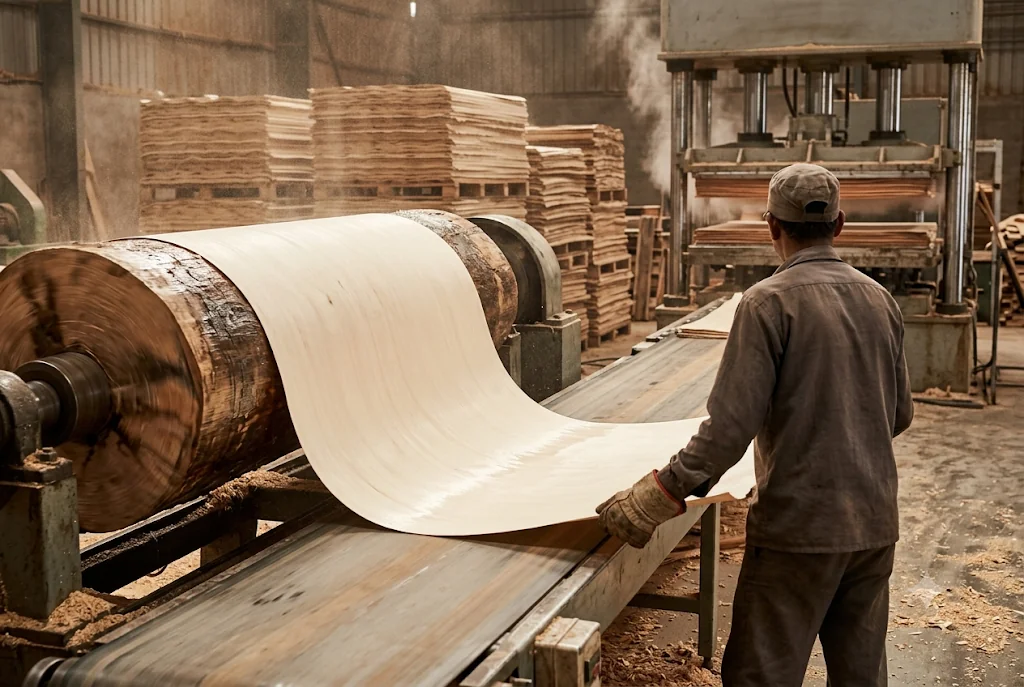
The Plywood Manufacturing Process
Step 1
Log selection
Plantation logs such as eucalyptus and poplar for the core, and hardwoods such as gurjan for the face veneers, are selected and debarked.
Step 2
Conditioning
Logs are soaked or steamed so the wood peels smoothly without splitting.
Step 3
Peeling
A rotary lathe spins the log against a knife and peels a continuous thin veneer, like unrolling paper.
Step 4
Clipping
The veneer ribbon is cut into sheets, and defects are cut out.
Step 5
Drying
Veneers are dried to a low moisture content so the glue bonds well and the board stays flat.
Step 6
Grading and patching
Veneers are sorted into face, back and core grades; small gaps are patched or jointed.
Step 7
Glue spreading
Resin is spread on the core veneers: urea formaldehyde for MR grade, phenol formaldehyde for BWP and marine grade.
Step 8
Lay-up
Veneers are stacked with the grain of each layer at right angles to the next, in an odd number of plies.
Step 9
Cold pressing
The stack is pre-pressed so the layers stay aligned.
Step 10
Hot pressing
Heat and high pressure cure the glue and bond the plies into one board.
Step 11
Trimming and sanding
Edges are trimmed to 8 × 4 ft, and faces are sanded; calibrated plywood is sanded to a tight thickness tolerance.
Step 12
Treatment and testing
Termite and borer treatment (often in the glue line), then quality checks such as the boiling-water test for BWP grades, and stamping of grade and batch.
What Each Step Means for Your Furniture
| Step | If done well | If done badly |
|---|---|---|
| Drying | Flat, stable board | Warping, bubbles and weak bonds |
| Glue grade | BWP survives water | MR glue delaminates if soaked |
| Cross lay-up | Strong in every direction | Sagging and splitting |
| Core patching | Gap-free core, good screw hold | Voids at the edges, loose hinges |
| Pressing | Even thickness, full bond | Soft spots and uneven sheets |
| Treatment | Termite and borer protection | Eaten from inside |
Grades explained: MR vs BWR vs BWP · IS:710 vs IS:303 · calibrated plywood.
Using This When You Buy
Look at the edge: even layers, no gaps and no overlapping veneers mean good lay-up and patching. Check the stamp: brand, grade (MR or BWP), IS mark and batch number. Feel the weight and thickness: a well-pressed 18 mm sheet measures close to 18 mm. Test an offcut for BWP: boil or soak it; see can plywood be waterproof. More checks: how to identify quality plywood · how to spot fake plywood.
How Blockboard, MDF and Flush Doors Are Made
Blockboard uses a core of solid timber strips between veneers; MDF is made from wood fibres and resin; flush doors combine a frame, a core and plywood skins. See blockboard manufacturing, how MDF is made and flush door manufacturing.
Samta Plywood Centre at Lati Bazar, near Gita Mandir, is a certified stockist of CenturyPly and Greenply, brands with controlled manufacturing and consistent quality. WhatsApp us your project for the right grade with today's rates and delivery across Ahmedabad.
Frequently Asked Questions
How is plywood made?
Logs are conditioned and peeled into thin veneers, which are dried, graded, coated with glue, stacked with the grain crossed at right angles, and hot-pressed into boards. The boards are then trimmed, sanded, treated and tested.
Why does plywood have an odd number of layers?
An odd number keeps the grain on both outer faces running the same way, so the board is balanced and does not warp.
Which glue is used in plywood?
Urea formaldehyde for MR (moisture-resistant) grade, and phenol formaldehyde for BWP and marine (waterproof) grades.
Which wood is used to make plywood in India?
Mostly plantation species such as eucalyptus and poplar for the core, often with hardwood face veneers such as gurjan.
What is calibrated plywood?
Plywood sanded to a tight thickness tolerance, so panels fit precisely in modular furniture.
How is plywood tested?
BWP and marine grades are tested for bond strength, including boiling-water tests, along with checks on thickness, moisture and density before stamping.
Why does manufacturing quality matter?
Poor drying, glue or pressing shows up as warping, delamination, voids and loose hinges. Branded plywood controls each step.
Want Well-Made Plywood?
WhatsApp us your project for the right grade and today's rates.