Laminate Guide · Special Laminates
Post-Forming Laminate: Curved, Seamless Edges Explained
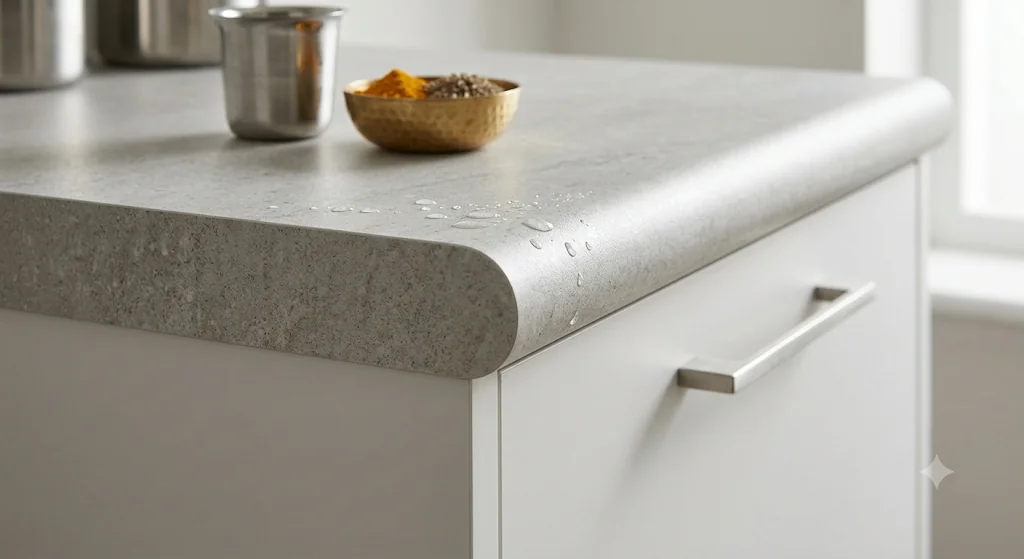
Ordinary laminate cracks if you try to bend it around a corner, so edges get a separate strip and a visible joint. Post-forming laminate is a special grade that softens with heat and wraps around a rounded edge in one piece, leaving no seam where dirt and water can get in.
What Is Post-Forming Laminate?
Post-forming laminate is a type of HPL made with resins that stay slightly flexible after pressing. When heated, it softens enough to bend around a rounded board edge and then hardens again as it cools. The same sheet covers the flat top, the curved edge and sometimes the underside lip, in one continuous piece.
It is usually a little thinner than standard 1 mm decorative laminate so it bends without cracking. Each brand gives a minimum bending radius, which is the tightest curve the sheet can take. Always design the edge profile to that figure.
How Post-Forming Is Done
Step 1
Profile the board
The plywood or MDF edge is machined to a smooth radius, such as a bullnose or a rounded drip edge, that is no tighter than the laminate's minimum radius.
Step 2
Bond the flat face
The laminate is glued to the top surface, leaving an overhang to wrap the edge.
Step 3
Heat evenly
A post-forming machine or controlled heater warms the overhang along its length. Too little heat cracks it, too much blisters it.
Step 4
Wrap and hold
The softened laminate is pressed around the curve onto adhesive and held until it cools and sets.
Post-forming needs controlled heat and pressure, so it is usually done in a workshop with a machine, not on site. Most modular furniture makers and some carpenters offer it.
Where Post-Forming Laminate Works Best
Table tops
Dining, study and cafe tables with soft, rounded edges that are comfortable on the arms and do not chip. See plywood for table tops.
Counters & worktops
A seamless front edge stops spills seeping into the board. This is common on office pantries and budget kitchen counters. See plywood for countertops.
Reception & retail
Curved reception desks, display counters and shop fixtures that take daily contact.
Shutters & profiles
Rounded shutter edges and handle-less grip profiles on kitchens and wardrobes.
Post-Forming vs Edge Banding vs Regular Laminate
| Post-formed laminate | Laminate + edge banding | Laminate + laminate strip | |
|---|---|---|---|
| Joint on edge | None on the curved edge | Thin line where tape meets top | Visible dark line at the corner |
| Edge shape | Rounded only | Square or slightly eased | Square |
| Water resistance at edge | Best | Good if well applied | Weakest; joint can open |
| Chipping | Low | Low | Corner can chip |
| Where done | Workshop with machine | Edge bander or by hand | On site by carpenter |
| Cost | Higher | Moderate | Lowest |
For square edges, good PVC edge banding is the practical choice. See our edge banding guide.
Tips Before You Order
Confirm it is a post-forming grade. Standard decorative laminate is not made to bend and will crack. Ask for the post-forming grade and the brand's minimum radius.
Choose the finish carefully. Deep textures and very high gloss can show stretch marks on tight curves. Matte and light textures usually form most cleanly. Compare in matte vs gloss vs textured.
Use a stable board. MDF or HDHMR machines to a clean radius. For wet areas, use a moisture-resistant core. See plywood vs MDF vs HDHMR.
Match the rest of the job. Order post-forming sheets in the same design as the flat laminate on the rest of the unit, from the same batch.
Post-forming availability varies by brand and design, so WhatsApp us the design you like and we will check stock. Our full range is on the laminate dealer page, and other special grades are covered in types of laminates.
Frequently Asked Questions
What is post-forming laminate?
Post-forming laminate is a flexible grade of HPL that softens under heat and bends around a rounded board edge, so the top and edge are covered in one continuous sheet with no joint.
Can normal laminate be bent around edges?
No. Standard decorative laminate is rigid and cracks when bent. Only a post-forming grade, heated correctly, can wrap a rounded edge.
Where is post-forming laminate used?
On rounded table tops, counter and worktop front edges, reception desks, retail counters and rounded shutter or handle profiles.
Is post-forming better than edge banding?
For rounded edges, post-forming gives a seamless edge with the best water resistance. For square edges, good PVC edge banding is simpler and cheaper.
Can post-forming be done on site?
It needs controlled heat and pressure, so it is usually done in a workshop with a post-forming machine rather than on site.
What is the minimum bending radius of post-forming laminate?
It depends on the brand and grade. Always check the manufacturer's stated minimum radius and design the board edge profile to be no tighter than that.
Is post-forming laminate more expensive?
The post-forming grade and the machine work both add cost compared with standard laminate and edge banding, but the seamless, water-resistant edge often justifies it on counters and table tops.
Want Seamless Rounded Edges?
WhatsApp us your design and we will check post-forming availability and matching flat sheets.