Laminate Guide · Special Finishes
Acrylic Laminate
Acrylic gives the deep, wet-look gloss of showroom kitchens. Here is what it is, how it compares with high-gloss HPL and PVC laminate, where it is worth the extra cost, and how to fit and care for it.
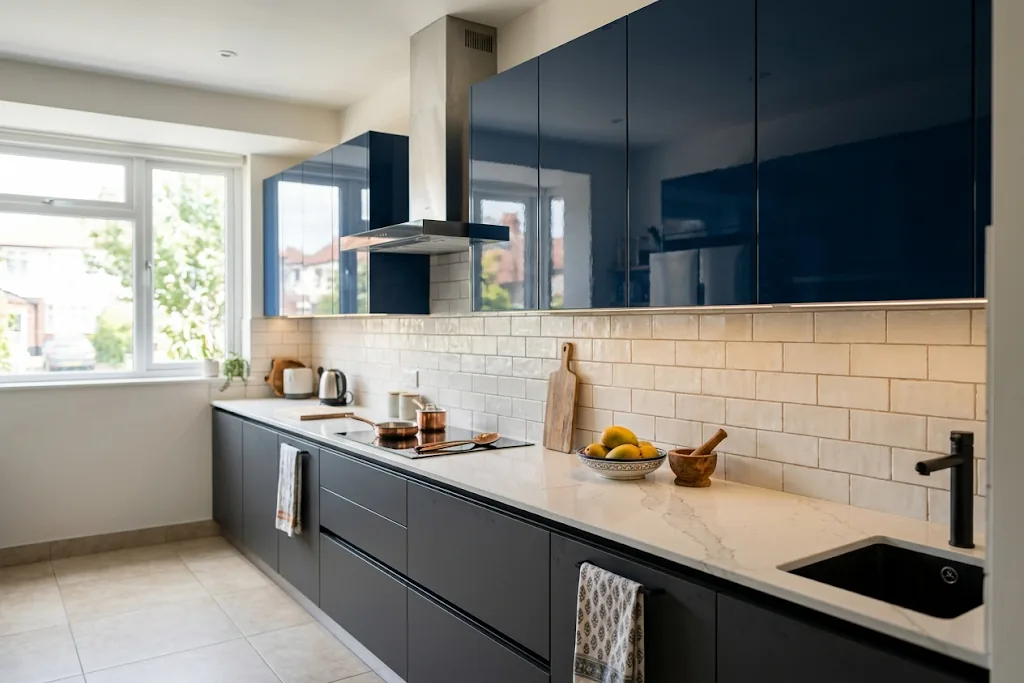
What Is Acrylic Laminate?
Acrylic laminate is a sheet with a solid layer of acrylic (PMMA) on top, usually about 1 to 1.5 mm thick, often backed for easy pasting. Its shine comes from the clear acrylic itself, not from a lacquer or a pressed paper finish. That gives it the deep, wet-look, almost mirror gloss you see in showroom kitchens, and colours look richer than on an ordinary high-gloss laminate.
It is easy to confuse three "glossy" options. High-gloss HPL is a standard decorative laminate pressed to a shiny finish. PVC laminate is a thin, flexible plastic film, often used on curved or post-formed shutters. Acrylic is the premium of the three: deepest gloss, best colour depth, and a higher price. The differences matter mostly in how they scratch, how they handle sunlight and what they cost.
Acrylic vs High-Gloss HPL vs PVC Laminate
| Factor | Acrylic | High-gloss HPL | PVC laminate |
|---|---|---|---|
| Gloss and depth | Deepest, mirror-like | Bright, slightly flatter | Good, varies by grade |
| Colour | Rich, saturated, uniform | Very wide range of designs | Wide; also woodgrains |
| Scratches | Shows fine scratches; light ones can be buffed | Shows scratches; can't be buffed | Softer; marks easily |
| Fingerprints | Visible | Visible | Visible on gloss grades |
| Curves | Flat panels; edges banded | Flat or post-formed | Bends round curves |
| Heat | Keep away from direct flame | Better heat tolerance | Keep away from heat |
| Price | Premium | Standard to mid | Budget to mid |
More on the standard options: high-gloss laminates, what HPL is and post-forming laminate.
Is Acrylic Worth It?
Pro
The best gloss you can buy
Nothing else gives the same depth on a flat shutter. Ideal where the kitchen is the showpiece of an open living area.
Pro
Colour that stays even
Solid, saturated shades look the same across every shutter, and good grades are UV-stable indoors.
Pro
Light scratches can be buffed
Because the top layer is solid acrylic, fine swirl marks can often be polished out. Laminate can't be.
Con
Shows fingerprints and fine scratches
Dark acrylic shows every mark. For daily-use base units, anti-fingerprint laminate is more practical.
Con
Costs more
Sheet, matching acrylic edge band and careful fabrication all add up. Budget for it on visible fronts only.
Con
Needs careful cutting
A fine-tooth blade, the protective film left on until fitting, and clean edges. Chips are hard to hide on gloss.
Where Acrylic Works Best
Kitchen wall units and tall units, which are seen more than they are touched. Wardrobe fronts in light or mid shades. TV units and feature panels. Handle-less kitchens where the gloss runs uninterrupted, as long as you accept fingerprints near the gola profile.
A popular approach in Ahmedabad kitchens is acrylic on the uppers, matte or anti-fingerprint on the base units. You get the gloss at eye level and a forgiving surface where hands, oil and haldi land. Colour pairings are in kitchen laminate colour combinations.
The right board underneath
Gloss shows every ripple, so the base must be dead flat. Use HDHMR or a good MDF for shutters, or calibrated plywood if you prefer ply, and balance the back face with laminate so the shutter stays flat. In wet zones, follow our MDF water guide.
Care
Peel the protective film only after fitting. Clean with a soft microfibre cloth and mild soapy water; never use scrubbers, abrasive powders, acetone or thinner. Buff light scratches with a non-abrasive polish made for acrylic. Keep hot pans and direct flame away from acrylic surfaces.
Acrylic, PU or Laminate for Your Kitchen?
If you want a gloss kitchen, you are choosing between acrylic sheet, PU paint and high-gloss laminate. Acrylic gives the deepest factory-made gloss. PU is sprayed on site or in a factory and can be repaired by re-spraying. High-gloss laminate is the most affordable. We compare them head to head in acrylic vs PU kitchen. For finish choice in general, see matte vs gloss vs textured laminate and laminate vs paint.
Acrylic laminate in Ahmedabad
Acrylic ranges, shades and rates change by brand. WhatsApp us the colour, quantity and use and we will share current options and rates. Standard gloss laminates with published prices are on our laminate price list, and all brands are on the laminate dealer page.
Frequently Asked Questions
What is acrylic laminate?
A decorative sheet with a solid layer of clear acrylic (PMMA) on top, usually about 1 to 1.5 mm thick. It gives a deeper, mirror-like gloss than ordinary high-gloss laminate.
Is acrylic better than high-gloss laminate?
For pure gloss and colour depth, yes. High-gloss HPL costs less, handles heat better and comes in more designs. Both show fingerprints.
Acrylic or PVC laminate: which is better?
Acrylic has deeper gloss and light scratches can be buffed out. PVC laminate is cheaper and flexible enough for curved or post-formed shutters.
Is acrylic laminate good for kitchens?
Yes for wall units, tall units and visible fronts. For daily-use base units, matte or anti-fingerprint laminate is more practical; keep acrylic away from direct flame.
Does acrylic laminate scratch easily?
It shows fine scratches, especially on dark shades, but light ones can often be buffed out with a non-abrasive polish because the top layer is solid acrylic.
What board should be used under acrylic?
A dead-flat board: HDHMR, good MDF or calibrated plywood, with the back face balanced so the shutter stays flat.
Planning a Gloss Kitchen?
Tell us the shade and quantity. We will share acrylic and high-gloss options with rates.