Comparisons · Door Construction
Flush Doors vs Wooden Doors
"Wooden door" usually means a solid timber door — heavier and more expensive than a flush door, with a warmth and longevity of its own, but also more upkeep. Current rates are on our flush door price list.
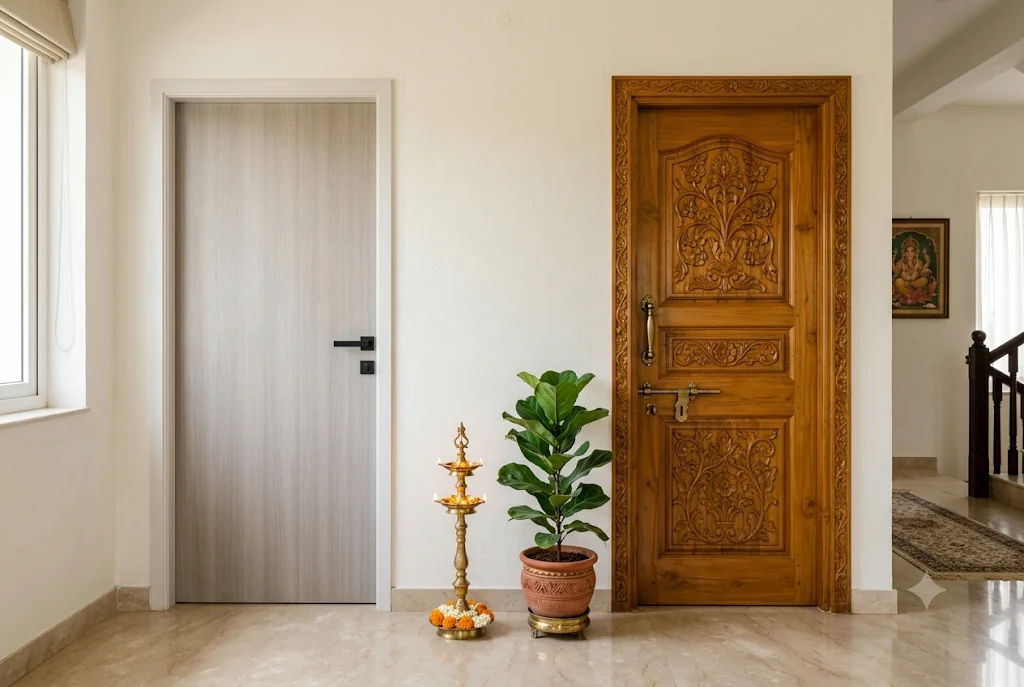
| Aspect | Flush Door | Solid Wooden Door |
|---|---|---|
| Construction | Engineered core faced with veneer or laminate | Solid timber, often with visible grain and joinery |
| Durability | 15–25 years typical, longer with a 35mm BWP door | Can last decades with proper refinishing |
| Price & value | Generally lower upfront cost | Higher upfront cost, reflecting raw timber |
| Maintenance | Simple flat surface, easy to clean and reseal | Needs periodic refinishing to manage natural movement |
| Humid environments | Performs well in BWP grade | Prone to swelling and warping without careful sealing |
| Acoustic & thermal insulation | Good with a solid or dense core | Very good, thanks to solid timber mass |
Where Each One Fits
Choose a Flush Door For
Consistent factory quality, a lower and more predictable cost, and reliable performance in humid rooms when built to BWP grade.
Choose a Solid Wooden Door For
A statement entrance, natural grain and character, and where budget allows for the higher upfront cost and ongoing refinishing.
A Related Question: Panel vs Flush
If the "wooden door" you're picturing is actually a framed panel door rather than a solid slab, see our flush door vs panel door guide instead. For plywood versus solid wood more broadly across furniture, our plywood vs solid wood guide covers the same underlying trade-offs.
Engineered Wood Door vs Solid Wood Door
“Engineered wood door” covers any door built from manufactured wood: flush doors on a pine or blockboard core, plywood-faced doors, WPC doors and HDF-skin doors. “Solid wood door” means a shutter built from timber such as teak, sheesham or sal.
| Factor | Engineered wood door | Solid wood door |
|---|---|---|
| Stability | Cross-layered core resists warping and cracking | Moves with humidity; needs seasoned timber |
| Water | BWP flush and WPC doors handle damp well | Swells unless sealed; teak copes best |
| Termites | Treated cores and WPC resist | Teak resists; many woods need treatment |
| Look | Any veneer, laminate or paint | Real grain, carving, heritage feel |
| Weight and fitting | Lighter, quicker to hang | Heavy; needs strong frame and hinges |
| Refinishing | Veneer can be re-polished; laminate replaced | Sand and re-polish many times |
| Cost | Lower | Higher: timber, carpentry, polish |
For a main door (7 × 3.5 ft) at our store: a 35 mm BWP flush door is about ₹3,724, or ₹6,144 with laminate on both faces; a Kitply 30 mm BWP about ₹4,508; a 30 mm WPC door about ₹5,488. A solid teak shutter needs roughly 4 cft of timber, about ₹8,800–9,600 in Ghana teak or ₹12,000–14,000 in Sudan teak before carving, polish and labour. Most Ahmedabad apartments now choose an engineered door with teak veneer for the look and stability; bungalows wanting carving still choose solid teak. See best wood for main door, teak wood door designs, veneer door designs and every door by room on door price.
Frequently Asked Questions
Do flush doors last as long as solid wooden doors?
A quality flush door, especially a 35mm BWP door, typically lasts 15–25 years, while a well-maintained solid wooden door can last decades longer with periodic refinishing — the gap narrows considerably with good care on both.
Are wooden doors more expensive than flush doors?
Yes, generally — solid timber costs more than an engineered flush door core, and that difference shows up directly in the upfront price.
Which performs better in humid conditions, flush or wooden doors?
A flush door built to BWP grade generally performs more predictably in humidity than solid wood, which can swell and warp with moisture unless carefully sealed and maintained.
Do wooden doors need more maintenance than flush doors?
Yes — solid wood needs periodic refinishing to manage its natural expansion and contraction, while a flush door's engineered core and factory finish need only routine cleaning and occasional resealing.
Which offers better sound insulation, flush or wooden doors?
Both perform well with a dense, solid construction; solid wood has a slight natural edge due to its mass, but a solid-core flush door comes close.
What is the difference between an engineered wood door and a solid wood door?
An engineered wood door is built from manufactured wood such as a pine or blockboard core with plywood faces, or WPC. A solid wood door is made from timber like teak. Engineered doors are more stable and cheaper; solid wood offers real grain, carving and can be refinished many times.
Is an engineered wood door good for a main door?
Yes. A 35 mm BWP flush door with teak veneer or laminate is stable, secure and much cheaper than solid teak. At our store, the 7 x 3.5 ft shutter is about ₹3,724 before GST.
Need the Right Board for Your Project?
WhatsApp us your requirement and we'll recommend the right grade and thickness.