Comparisons · Panel vs Timber
Plywood vs Solid Wood
Solid wood has a warmth and value that plywood can't fully replicate, but plywood's cross-laminated structure resists warping and movement far better across large panels.
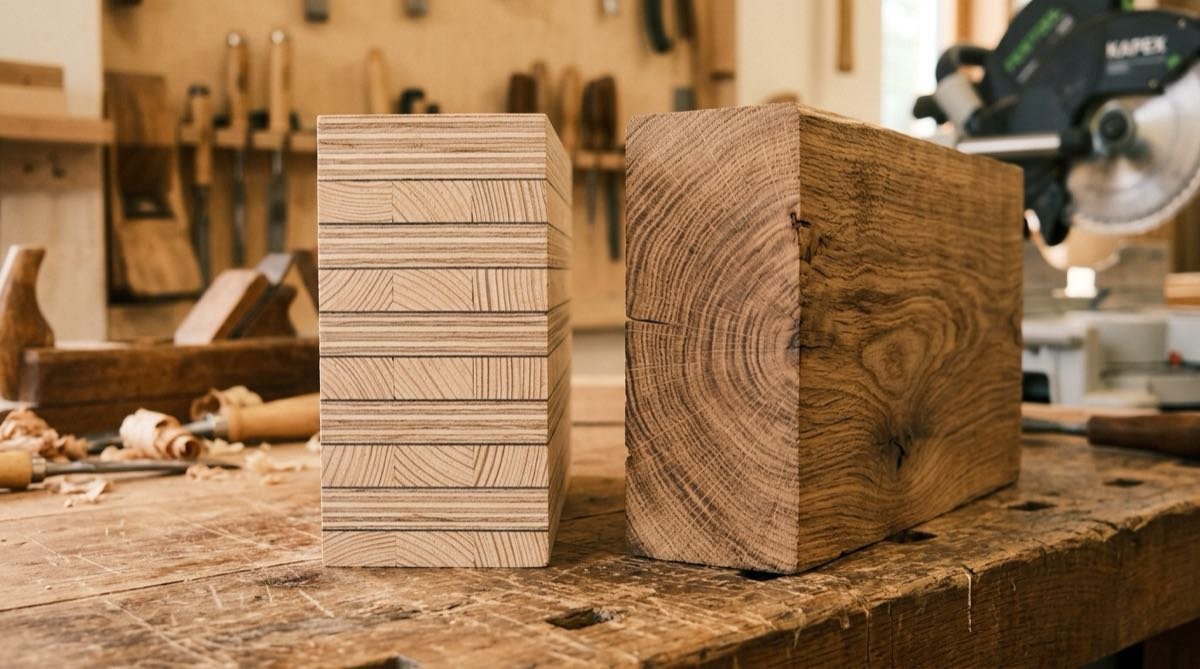
| Aspect | Plywood | Solid Wood |
|---|---|---|
| Dimensional stability | High, resists warping across width | Can expand, contract or warp with humidity changes |
| Panel size available | Large sheets (8x4 ft) as standard | Limited by tree width, needs jointing for large panels |
| Weight | Lighter | Heavier |
| Typical cost | Generally lower | Generally higher |
| Repairability | Limited — thin face veneer | Can be sanded and refinished many times |
| Best use | Carcasses, large flat panels, budget-conscious builds | Statement furniture, exposed solid components, heirloom pieces |
Where Each Material Earns Its Place
Choose Plywood For
Wardrobe carcasses, cabinet boxes, shelving and any large flat panel where dimensional stability and budget matter more than solid-wood character.
Choose Solid Wood For
Tabletops, exposed legs and frames, and statement pieces where the natural grain, weight and long-term refinishing potential justify the cost.
Most Furniture Uses Both
A well-built piece often combines a plywood carcass for stability and cost efficiency with solid wood accents — legs, edge trims, tabletops — where the extra character and durability of solid timber is worth showing off. Popular solid wood species for these accents include hardwoods like teak, oak and walnut for a richer grain and tone, or softwoods like pine for a lighter, more affordable option. See our advantages of plywood guide and our best material for interior furniture guide for more on choosing the right combination for your project.
For the solid-timber side, our current per-cft rates cover Burma teak, Sudan teak, pine and white ash — see the full timber price list.
Frequently Asked Questions
Is plywood cheaper than solid wood?
Generally yes — plywood is typically less expensive than solid wood of comparable size and quality, largely because it uses thinner veneer layers rather than a full board of premium timber.
Does plywood warp less than solid wood?
Yes, in most cases — plywood's cross-laminated layers balance internal stress and resist the expansion and contraction that solid wood undergoes with humidity changes.
Can solid wood furniture be refinished more than plywood?
Yes — solid wood can be sanded down and refinished multiple times over its life, while plywood's thin face veneer limits how much sanding it can safely take before wearing through.
Is solid wood always better quality than plywood?
Not necessarily — both have strengths; plywood offers better dimensional stability and is often the more practical choice for large flat panels, while solid wood offers natural character and refinishing longevity.
Can I combine plywood and solid wood in the same piece of furniture?
Yes, this is common practice — using a plywood carcass for the main structure and solid wood for visible components like legs or tabletops balances cost, stability and appearance.
Need the Right Board for Your Project?
WhatsApp us your requirement and we'll recommend the right grade and thickness.